

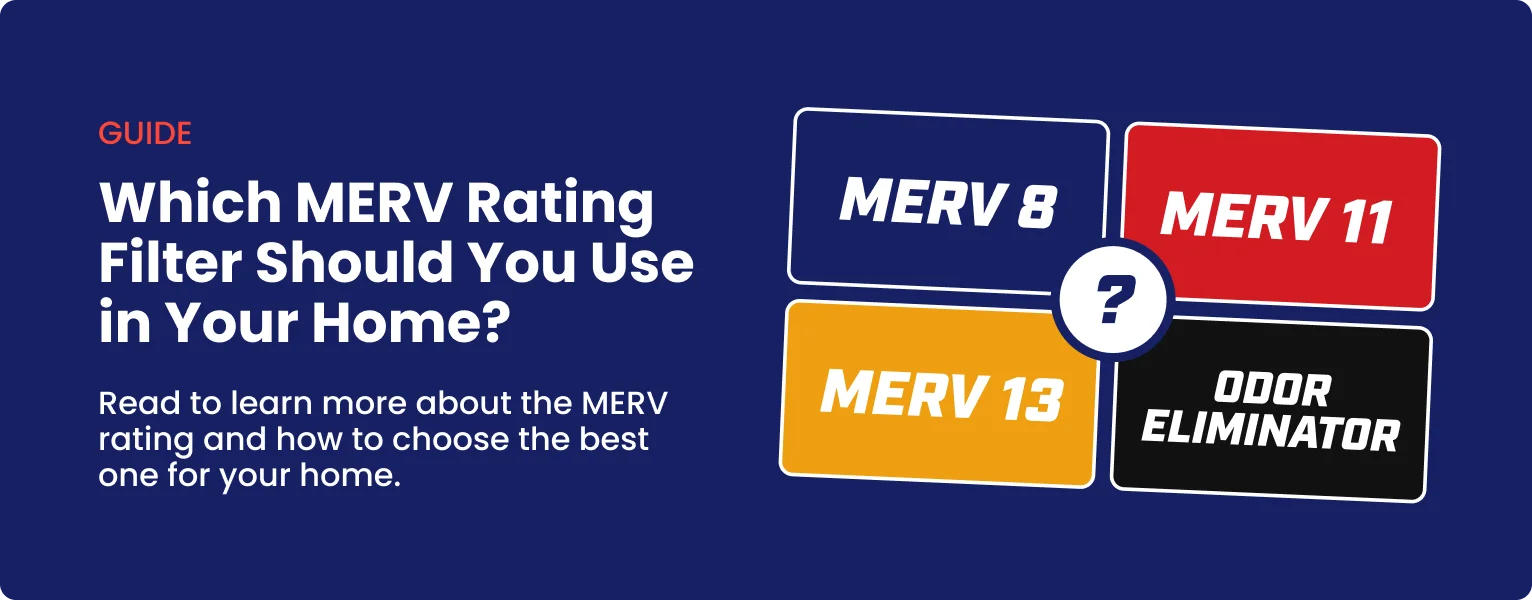

Most homes should use a MERV 8, MERV 11, or MERV 13 air filter. MERV is a 1–16 score for how well a filter traps particles from 0.3 to 10 microns. Choose MERV 8 for homes without allergies, MERV 11 for pets or kids, and MERV 13 for allergies, asthma, or smoke if your system can handle it.
Which MERV rating should you use in your home?
Use the MERV rating that matches who lives in your home and what your system can handle:
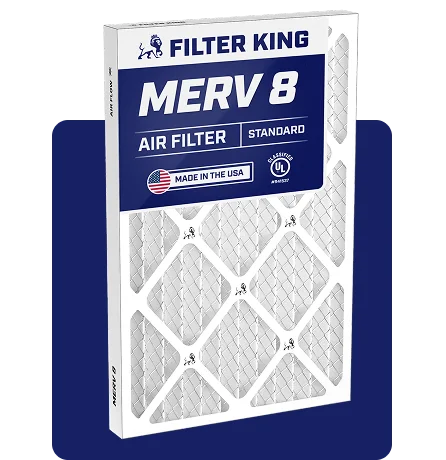
- Choose MERV 8 air filters for standard homes without allergies. They capture up to 90% of common particles, such as dust mites, pollen, pet dander, lint, and mold spores.
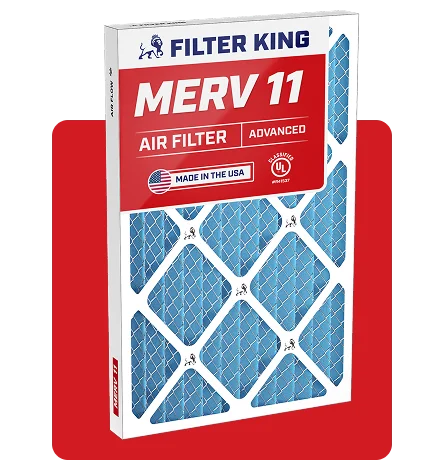
- Choose MERV 11 air filters for homes with pets, kids, moderate allergies, or city air. They capture up to 95% of common particles and add fine dust, smoke, and smog particles.
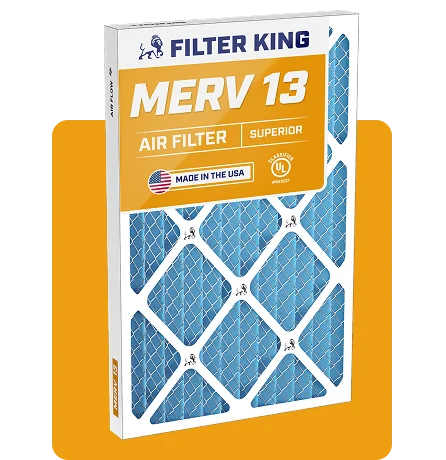
- Choose MERV 13 air filters for allergies, asthma, weakened immune systems, wildfire smoke, or nearby construction. They capture up to 98% of common particles, including bacteria and virus carriers.
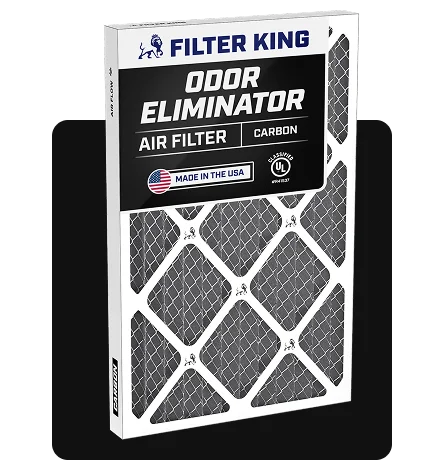
- For odors, choose a MERV 8 Carbon air filter. It traps particles at the MERV 8 level and absorbs odors, VOCs, and cooking smells, but doesn't replace MERV 13 for allergies.
Check your system before you move up to MERV 13. Static pressure is the resistance your blower pushes air against, and a denser filter raises it, so older or low-powered systems may lose airflow. Our guide on whether MERV 13 filters are worth the money helps you decide, and you can find your size among our stocked sizes, such as the 25x25x1 air filter.
What does MERV mean on air filters?
MERV stands for Minimum Efficiency Reporting Value. A filter's MERV rating shows how well it captures airborne particles, and a higher rating means it traps more small particles.
Higher isn't always better, because high-MERV filters can restrict airflow in some systems. The right MERV rating balances filtration with what your HVAC system can handle.
What does a MERV rating measure?
A MERV rating measures how well a filter captures particles by size, in microns. One micron is one-millionth of a meter.
Filters are tested against particles from 0.3 to 10 microns, such as dust, pollen, mold spores, and some bacteria. The rating reflects the filter's lowest measured efficiency, so it shows the minimum performance you can expect.
How does the MERV scale work?
The MERV scale runs from 1 to 16, and each level shows how well a filter captures particles in specific size ranges. The EPA's MERV chart, last updated in 2024, covers MERV 1 through MERV 16.
- MERV 1–4 filters trap larger particles like lint and dust.
- MERV 5–10 filters also catch mold spores and pet dander.
- MERV 11–12 filters also catch fine dust and smoke particles.
- MERV 13–16 filters also capture bacteria and virus carriers.
Why does the MERV rating matter?
The MERV rating lets you compare filters from different brands on the same scale, so you can choose the right one for your needs. For example, if someone in your home has allergies, a higher MERV rating will catch more of the particles that trigger them.
The MERV scale also helps you balance air quality with energy use. In some homes, a lower MERV rating cleans the air well enough and keeps airflow strong.
How do you read a MERV rating chart?
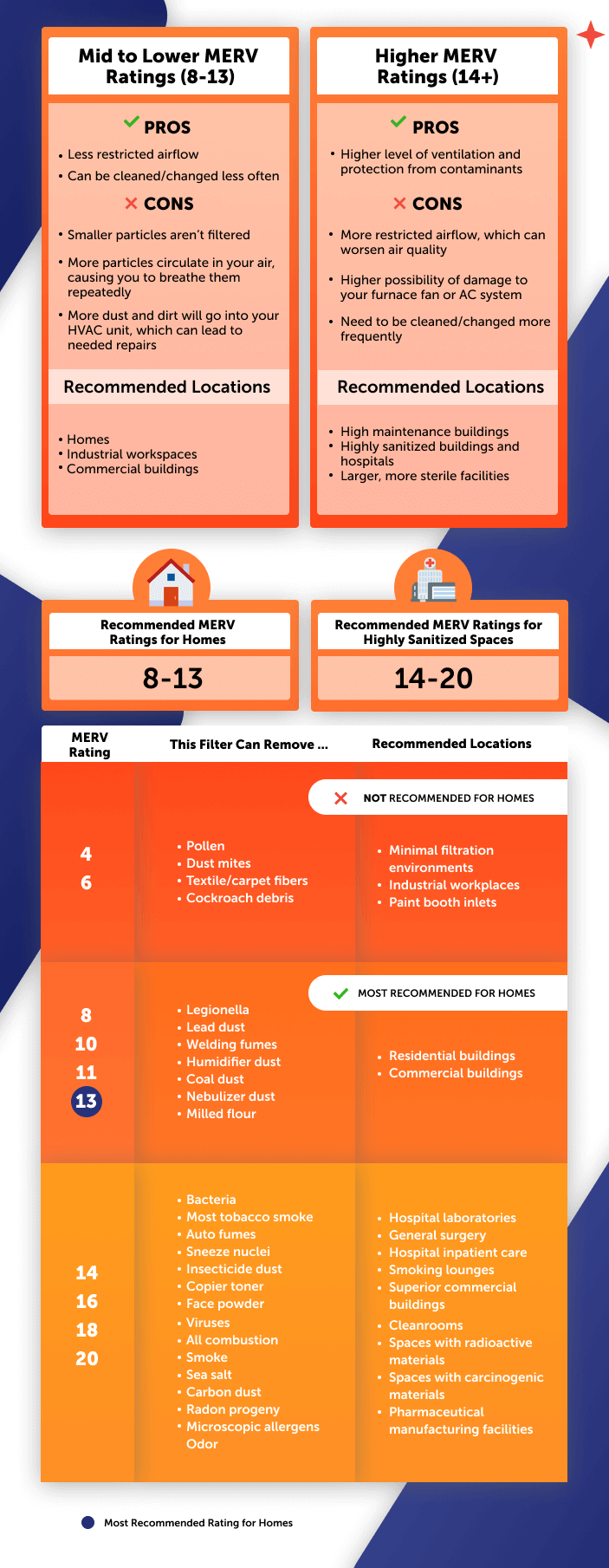
A MERV rating chart lists, for each rating, the minimum share of particles a filter captures in three size ranges: 0.3–1 micron, 1–3 microns, and 3–10 microns. As the rating goes up, the filter catches a larger share of smaller particles.
The MERV scale is an industry standard from ASHRAE (the American Society of Heating, Refrigerating and Air-Conditioning Engineers), so you can use it to compare different brands of air filters. The chart below uses the EPA's MERV chart, last updated in 2024.
| MERV rating | 0.3–1 micron | 1–3 microns | 3–10 microns |
|---|---|---|---|
| MERV 1–4 | No minimum | No minimum | Less than 20% |
| MERV 5 | No minimum | No minimum | 20% or more |
| MERV 6 | No minimum | No minimum | 35% or more |
| MERV 7 | No minimum | No minimum | 50% or more |
| MERV 8 | No minimum | 20% or more | 70% or more |
| MERV 9 | No minimum | 35% or more | 75% or more |
| MERV 10 | No minimum | 50% or more | 80% or more |
| MERV 11 | 20% or more | 65% or more | 85% or more |
| MERV 12 | 35% or more | 80% or more | 90% or more |
| MERV 13 | 50% or more | 85% or more | 90% or more |
| MERV 14 | 75% or more | 90% or more | 95% or more |
| MERV 15 | 85% or more | 90% or more | 95% or more |
| MERV 16 | 95% or more | 95% or more | 95% or more |
| HEPA | 99.97% at 0.3 microns | More than 99.97% | More than 99.97% |
HEPA (high-efficiency particulate air) filters sit above the MERV scale and are rated under a separate standard. The EPA notes that 0.3 microns is the hardest particle size to catch, so a HEPA filter traps larger and smaller particles at even higher rates.
What can each MERV rating range remove?
Each MERV range removes a different set of particles, from lint and dust at MERV 1–7 to bacteria and virus carriers at MERV 13–16. Here's what each range catches and where it's used.
MERV 1–7
MERV 1–7 filters are the lowest range and offer basic protection. Most aluminum, mesh, and low-cost flat filters fall in this range.
What it can remove
MERV 1–7 filters mainly catch large particles such as dust mites, spray paint dust, carpet fibers, and pollen. The EPA's chart shows MERV 1–4 filters capture less than 20% of particles from 3 to 10 microns, and MERV 7 filters capture at least 50%.
Pros:
- Low cost
- Let air flow freely, so they're easy on your HVAC system
Cons:
- Only filter out the largest particles
- Not a good choice for people with allergies or asthma
Recommended use: basic equipment protection
MERV 1–7 filters are best for protecting HVAC equipment from dust when cleaning the air of small particles isn't a priority. Our MERV 4 air filter review and MERV 6 filter review cover this range in more detail.
MERV 8–13
MERV 8–13 filters are the right range for most homes and many businesses. They're the recommended range for home furnace filters.
What it can remove
MERV 8–13 filters remove mold spores, lead dust, cooking dust, flour, and hair spray particles. The EPA's chart shows a MERV 8 filter captures at least 70% of particles from 3 to 10 microns, while a MERV 13 filter captures at least 50% of particles from 0.3 to 1 micron.
Pros:
- Suitable for people with allergies or asthma, especially at MERV 13
- Block a wider range of particles
Cons:
- Cost more than low-MERV filters
- MERV 13 can reduce airflow in older or low-powered systems
Recommended use: homes
Filters in the MERV 8–13 range give a good mix of filtration and airflow for most homes. Read more about MERV 8 vs MERV 11 to compare the two most common choices.
MERV 14–16
MERV 14–16 filters offer the highest filtration on the MERV scale and are rarely needed in homes. HEPA and ULPA filters are rated on separate standards, not the MERV scale.
What it can remove
MERV 14–16 filters remove smoke, bacteria, sneeze droplets, carbon dust, and many virus carriers. The EPA's chart shows a MERV 14 filter captures at least 75% of particles from 0.3 to 1 micron, and a MERV 16 filter at least 95%.
Pros:
- Very high filtration
- Catch most bacteria and virus carriers
Cons:
- Expensive
- Restrict airflow in most home systems
Recommended use: hospitals and laboratories
MERV 14–16 filters are mainly used in hospitals, operating rooms, and labs, where air needs to be as clean as possible. Our MERV 16 filter review covers when this level makes sense.
How do MERV, MPR, and FPR ratings compare?
MERV is the industry standard for every brand, while MPR and FPR are brand scales from 3M and Home Depot. MPR (Microparticle Performance Rating) is 3M's scale for its Filtrete filters, and FPR (Filter Performance Rating) is Home Depot's scale for the filters it sells.
Each scale measures filtration differently, so compare filters from different brands by their MERV rating. Our guide to MERV, MPR, and FPR ratings explains what each scale means and how the ratings line up.
